

Space Monitor: an update
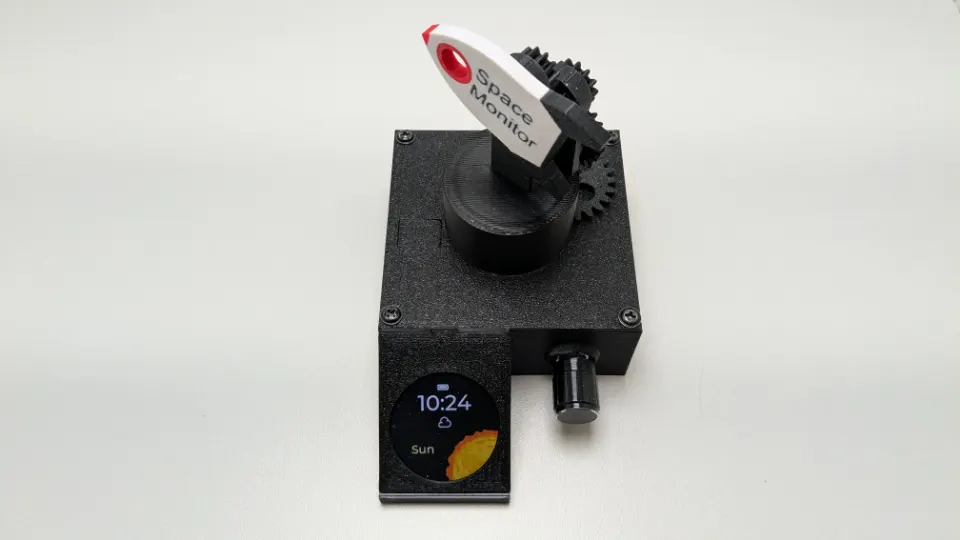
A lot has changed on the Space Monitor since my last post. Time for an update: what I’ve improved in the software, the hardware and the 3D model, plus two timelapses of Mars and the ISS.
Firmware
- Battery management. The battery percentage is now accurate, and the Space Monitor knows when the charging cable is plugged in.
- The weather. Every ten minutes it fetches the current weather and shows it as an icon: rain, clouds, snow.
- Tracking Mars and the ISS. Besides the sun and the moon, it can now follow Mars and the International Space Station in real time.
- Connect with a QR code. Scan the code on the screen and your phone joins the Space Monitor’s own Wi-Fi network straight away.
- Memory management and factory reset. Memory is handled better, and if you ever need to, you can reset everything to factory settings.
- More stable and faster. I fixed a number of bugs, updated the operating system and polished the controls in lots of small ways.
Hardware
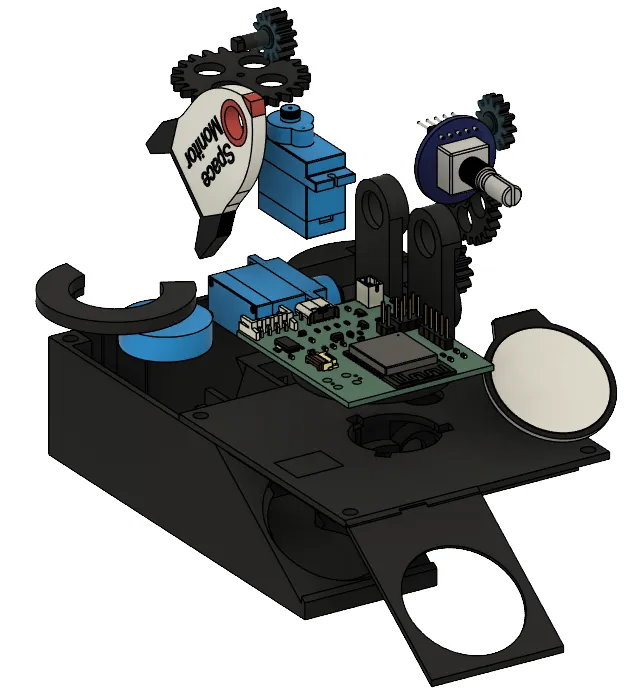
- A faster chip. The new ESP32-S3 is much more powerful and has more memory.
- Parts that suit the motors better, so the moving parts, like the rocket, run more reliably.
- A new screen with a flat cable connector, which makes fitting and wiring it much easier.
- Status LEDs, so you can see at a glance what state the device is in.
- A connector for an extra sensor. Later on, a sensor will go there to find north.
3D model
- A new rocket that points at objects in the sky more clearly.
- Less play in the gears. Movements are now much smoother and more precise.
Timelapses
You can see how it works best in motion. In these two timelapses, the rocket follows Mars and the ISS for a few hours:
What’s next
- Updates over Wi-Fi, so new firmware arrives remotely.
- A sensor for north, so it calibrates itself.
- Showing movement ahead of time: how the planets will move over the next hours or days.
- Tracking more planets: Venus, Mercury, Jupiter, Saturn, Uranus and Neptune.
So there’s plenty still to do. For now I’m happy with how far it has come, and I’m looking forward to building on it.